An Explanation for Marfa Lights

digg del.icio.us TRACK TOP
By Jonathan Whitcomb | Filed in Cryptozoology | No comments yet.

I don’t often review a book chapter, but the mysterious ghost lights of Marfa, Texas, keep grabbing my attention. Chapter Six of the third edition of Live Pterosaurs in America explains the more mysterious of the various types of Marfa Lights. The scientist James Bunnell calls this type of mystery light “CE-III.” Let’s begin with quotes from Chapter Six.

But if the lights are made by ropen-like animals, why would they move like that? . . . ropens in Texas might be hunting bats, but how could dancing help them catch bats? Insects! Of course lights attract insects. After two ropens have glowed in one area long enough to concentrate insects, they separate for awhile to allow the bats to feel safe in catching those insects. Soon the ropens return to catch the bats.

. . . Mr. Bunnell the scientist has lived around Marfa, Texas, for much of his life. . . . he had assumed that somebody had already done the research and had explained what caused Marfa Lights . . . how surprising when he found that nobody had come up with a convincing explanation! (James Bunnell, apparently, knew nothing about ropens in New Guinea; he considered only Marfa Lights interpretations involving light-sources non-living. I communicated with him by emails, early in 2010.)

. . . On May 7th and 8th, 2003, extraordinary events were photographed [by James Bunnell). On the first night, lights appeared between 9:00 and 10:40. The first light was too brief for Bunnell to photograph, but two more appeared at about the same location. I was intrigued at Bunnell’s description of how those two lights behaved, for it seemed consistent with my hypothesis that Marfa Lights are made by flying predators with extreme bioluminescence, like the ropen of the southwest Pacific but used for a different purpose: to attract insects that attract the Big Brown Bat.

. . . According to Bunnell’s notes, sunset on May 7th was at 8:36 p.m.; there was no wind and the temperature was “about 70 degrees F.” I wonder: Could it have been warm enough at 10:40 p.m. for insects to be flying around? I believe so.

. . . the other two ropens, the ones streaking back to that location, were also driven by hunger . . .

. . . So why did the two lights of May 7th go out before reaching the original location? Think about it. Several bats are grabbing a few insects while also keeping track of a nearby dancing, glowing bat-eater. Is it really a free lunch? The other two bat-eaters, having turned off their glow, are streaking into that area at high speed, relying on the dancing bat-eater to hold the attention of the bats.

Speculation in the Explanation

Until somebody, James Bunnell or some other scientist perhaps, videotapes or photographs a flying predator chasing or catching a bat around Marfa, Texas, this flying-predator hypothesis is speculative. But it explains perfectly well much of the behavior of the CE-III flying lights that are commonly called “Marfa Lights.” The Pterosaur Eyewitness blog deserves quoting (Feb 2, 2012: “Marfa Lights Explanation”):

We need to consider the apparent intelligence in the movements of those CE-III Marfa Lights, for sometimes some things are exactly as they appear to be, in this case, intelligent. When residents of Marfa, Texas, . . . have observed the more mysterious flying lights . . . they recognize an intelligence in the “dances.” A light sometimes will split into two lights and the two will slowly separate . . . eventually turning back as they approach each other, like in a square dance. . . . Why do so many outsiders, scientists or not, assume that all those residents must be wrong when those local people ascribe intelligence to some of those lights (the ones Bunnell labels “CE-III”)? How we need common horse sense!

. . . The light splittings probably relate to a specific hunting technique. Bioluminescent flying predators attract insects with their glowing. They separate for a short while, allowing Big Brown Bats to go after those flying insects. The larger predators then reunite to try to catch bats, although they may not both remain glowing all the way back, for that would alert the bats.

Gitmo Pterosaur may be related to creatures around Marfa, Texas

Tags:

The Alchemist

digg del.icio.us TRACK TOP
By Jonathan Whitcomb | Filed in Religion | No comments yet.

The great majority of reviewers on Amazon.com give The Alchemist five out of five stars. Before quoting parts of some of the most favorable and unfavorable ones, I’ll relate my own experience. I did not feel transported into another world, which is what I enjoy about fantasies, but this allegorical novel by Paulo Coelho is meant to help transport readers along the journey of life in the real world, when they are not reading anything. Judging by the worldwide popularity of The Alchemist, I believe that it is succeeding. Note these Amazon reviews:

A Useful Symbolic Story

“Simple fable” fits well when comparing “The Alchemist” with a realistic novel, but the lessons to be learned for our lives (or renewed for what we have forgotten) multiply like sand dunes of the Sahara. At least something in the story can be applied in each person’s life. Be aware: This is a symbolic story; it’s not about finding material treasure.

All the Universe can be observed in a single grain of sand

These are lessons that we all know in our hearts, but that we forget as we get wrapped up in the hustle and bustle of our material lives. Lessons about listening to our hearts and following our dreams. . . .  Lessons about freeing ourselves from fear and about understanding our lives as part of the energy of the Universe and understanding that everything will work out the way it was intended to. Lessons about trusting in signs, knowing that our lives have a grand purpose and that the forces of the Universe will conspire to help us fulfill that purpose.

Flawed But Ultimately Thought-Provoking and Worthwhile

Yes, much of what negative reviewers of this book have to say is true: the writing is blunt and simple, the characters lack depth and complexity, it is quite male-focused in its subject matter and language, it has a bunch of quasi-religious mumbo-jumbo, and so on. This book should not be put on the list of great literature for the ages. . . . And yet, I have to say – and I feel a bit sheepish about this – that I found it meaningful, even profound at times. How can I say this, given my criticisms? First of all, unlike many reviewers, I did not approach this book with great expectations. No one told me that this was Shakespeare or Tolstoy; I had never even heard of it until it was recommended to me recently. And by the end of page 2, I had adjusted my expectations further. . . .  I suspect that through his simple tale, he is trying to provide some kind of argument against the kind of cynicism or fear that the world can sometimes instill in us, and encourage us to keep diving into that “strong current” to see where it takes us.

Tags:

Live Pterosaurs in America

digg del.icio.us TRACK TOP
By Jonathan Whitcomb | Filed in Cryptozoology | One comment

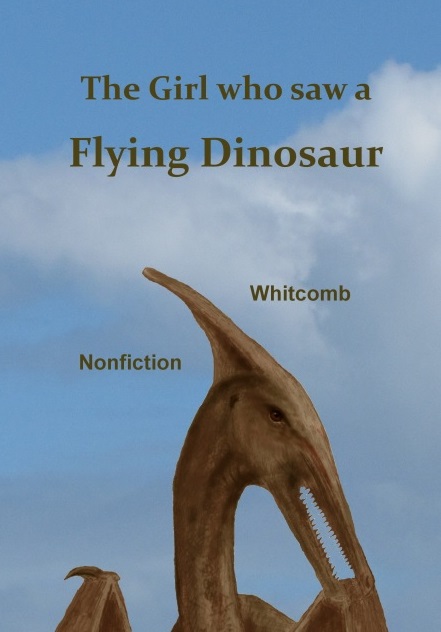
With a title suggesting fiction, this book flies against the wind of popular scientific assumptions about pterosaur extinction. Live Pterosaurs in America is nonfiction. The second edition, published in November of 2010, includes a chapter about the Marfa Lights of Texas, offering a revolutionary conjecture: They are from the flights of bioluminescent predators, perhaps related to the ropen of Papua New Guinea, perhaps even living pterosaurs. Let’s take a peek at this book’s introduction, at least the first page of it.

This book might make a few Americans uneasy to walk alone at night; my intention, however, is not to frighten but to enlighten as many readers as possible to know about live-pterosaur investigations. Those who’ve been shocked at the sight of a flying creature that “should” be extinct—those eyewitnesses, more numerous than most Americans would guess, need no longer be afraid that everyone will think them crazy, and no longer need they feel alone. Those of us who’ve listened to the American eyewitnesses, we who have interviewed them, we now believe. So, if you will, consider the experiences of these ordinary persons (I’ve interviewed most of them myself) and accept whatever enlightenment you may.

This book might discomfort, even offend, a few readers; please consider the feelings of those who have revealed to us their encounters with what seem to be live pterosaurs, for some of them have suffered more than discomfort. I intend to comfort those innocent victims who have been ridiculed or ostracized because of a cultural weakness, for each has seen something unaccepted by their society. Each eyewitness deserves listeners who will open their minds, really listen. Consider their experiences.

If this book does nothing more than comfort the eyewitnesses of strange creatures, I would be grateful; but there’s much more. We need to understand why we believe what we believe. When I first began researching these eyewitness sightings, years ago, I mentioned a word to a kindergartner: “pterosaurs;” he said, “A comet.” Years later, while writing this book, I mentioned my work to a second-grader; she said, “Who will buy your book? Crazy people?” I think better of you. And I think, because of what she and many others have told me, that we must understand indoctrination, for it influences our beliefs; the extent of that influence discomforts me.

My American associates and I who have explored in Papua New Guinea, searching for living pterosaurs, intend no deceit; we intend only enlightenment. Ten expeditions, within sixteen years, have rewarded us with many eyewitness accounts and video evidence for what we believe is the bioluminescence of a flying creature; but we still lack a clear photo of a pterosaur. We have been labeled foolish, biased, and crazy; but the few who say “lies” reveal their own foolishness: Why would we work so hard, for so long, with so many opportunities to fabricate pterosaur sightings in so many remote jungles, and then admit that we never saw any clear form of a pterosaur? It is because we intend not to deceive but to enlighten.

The third edition has recently been published:

non-fiction cryptozoology book on living pterosaurs in the USA

Tags: ,

Embraced by the Light

digg del.icio.us TRACK TOP
By Jonathan Whitcomb | Filed in Religion | No comments yet.

Human experience should catch our attention, even when clamorous human philosophy demands otherwise. In the nonfiction Embraced by the Light, Betty Eadie shares her 1973 Near Death Experience (NDE), her spiritual flight from a hospital bed to worlds beyond number and beyond description. I know of nobody who takes this book as scripture or as a writing of pure truth untainted by any aspect of Eadie’s personal philosophy or human frailties; I suspect a few do. But how can any pure truth from those lofty realms of heaven be adequately framed in human language? Nevertheless, we have a choice to follow higher beams of light, and to try to rise above the errors of human philosophy, or to try to become satisfied with something less.

This experience of an average housewife-mother, an experience of life on the other side of what we call death—this deserves better than summary dismissal out of fear of the unknown; EBL also deserves better than careless dismissal of those points seeming to contradict ones personal philosophy, as if Eadie had created her NDE to promote her own philosophy. This was a human experience that changed her life and her philosophy; if demands our attention.

Learn from Eadie’s experience of encountering the love that dispels all fear. When we trust in God first, offering up our imperfect philosophies to be, by God’s hand, molded or replaced by the truth, then we become prepared for those higher truths that many try to obtain out of order. The first step is faith in God; what human stride is long enough, without faltering, to stretch over that first step? When Eadie was encompassed by the love of God, her fears of an avenger-God evaporated in the light; that encouraged her to ask what she otherwise would have feared to ask.

Thoughts and feelings I’ve gained from reading this book several times over several years—that I now relate, for my copy of Embraced by the Light I’ve missplaced. But I offer some thoughts on a few objections I’ve heard and read, and I ask for the open heart that is only possible when we walk into the light, even if it is only a tiny beam of that enormous light that vanishes fear.

“Amazon.com Review”

To avoid bulverism, Eadie’s personal human frailties, real or imagined, should not be emphasized, but the “Amazon.com Review,” by Brian Patterson, says that her vision of the afterlife is ”heavily filtered through Eadie’s Christian worldview.” The problem with that heavy phrase, in that short one-paragraph review, becomes obvious when we ask, “But Mr. Patterson, what is your own worldview?” Each human who has graduated from diapers is old enough to have a worldview, but we don’t usually draw attention to the potential subjective and imperfect nature of foundational beliefs . . . unless somebody says something contrary to our own philosophy.

An objective examination of Betty Eadie’s NDE throws grave doubt on Patterson’s declaration that the vision itself was greatly influenced by her worldview; her present view of the world (and other worlds) was, on the contrary, formed FROM that experience. Thoughtful readers of Embraced by the Light will perceive that Eadie’s prior Christian ideas were turned upside down, in some aspects, by her NDE. Mr. Patterson seems to have gotten the influence-direction reversed in his mind.

I found it strange that Brian Patterson wrote that Embraced by the Light ”will undoubtedly raise a lot of questions along the lines of ‘What about reincarnation?’ and ‘What happens to people who are not Christians?’” His statement raises the question, “Did Mr. Patterson read this book with a mind open?” To the best of my memory, EBL answers those questions clearly.

At the beginning of the NDE, Eadie encounters Jesus Christ and learns that she has completely misunderstood him. But the Savior does not condemn her for her ignorance, which came by her being misinformed during her youth; he teaches her with love and acceptance. This makes it clear that those who have innocently disbelieved in Jesus Christ will not be condemned by him, when mortal life ends. Non-Christians do not automatically go to hell after death, for being non-Christians. That answers Patterson’s remark about those who are not Christians.

Eadie was told that reincarnation is a false concept; that answers Patterson’s remark about reincarnation. In fact, Eadie is told one reason why some persons have come to believe in reincarnation, making it clear that the philosophy is fallacious.

Perhaps some reviewers and commenters confuse basic concepts about human equality. We have equal right to choose what philosophy to believe, but that does not make all philosophies equally valid or equally full or truth or equally full of error. Absolute truths about human origins and life after death and the role of Jesus Christ—they do not depend on what human philosophy or religion a person has chosen.

Tags: